
Designing for Adult Social Care: Supporting Shared Lives Plus
Shared Lives Plus is a charity that prides itself in championing one of the most human-centred service models in adult social care - Shared Lives. Based in Liverpool, Shared Lives Plus supports the community across the UK through its membership, growth and development support. Shared Lives schemes connect people who need support with approved and trained carers who welcome them into their homes and lives. The model is built on trust, relationships and a sense of belonging.
Like many organisations in the sector, Shared Lives schemes face practical challenges as they grow. Matching people with the right carers can be time and resource intensive. It is often difficult to see which carers are available locally, and people seeking support do not always have much control over the process.
Shared Lives Plus joined our Adult Social Care Testbed, delivered in partnership with the National Care Forum, last summer. They were looking to explore whether a digital approach could help, without losing what makes the service special.

Working in partnership with our Design Manager, Joe Bramall, and technical professionals from the University of Liverpool’s Virtual Engineering Centre (VEC), the project started with research, not technology. The team worked closely with Shared Lives Plus, schemes, carers and people who draw on care, to understand how matching currently works and where it can break down. Early prototypes were tested in real contexts to see what made sense, what didn’t and what needed to change. This helped map the service from multiple perspectives and define what a digital product would need to do as part of that wider system.
Crucially, it also clarified what it should not try to do.
From this early work, a set of clickable prototypes was developed and reviewed with Shared Lives Plus before any build began. This process was not just about shaping a product - it helped the team build confidence in evaluating and directing digital development themselves, something that will be critical as the work continues.
With a clear direction in place, the VEC developed a minimum viable product, focused on testing the core value of the idea in practice rather than overbuilding too early.
Joe Bramall, Design Manager at the CHI-Zone, said:
“The real project strength came from designing collaboratively. Shared Lives Plus brought a deep understanding of how the model works day-to-day, where the pressures are and what really matters to the people involved. Together with the VEC, our role was to bring design and technical capability, working collaboratively to shape something that fits into the service, supports it and has the best chance of working in practice far into the future.”
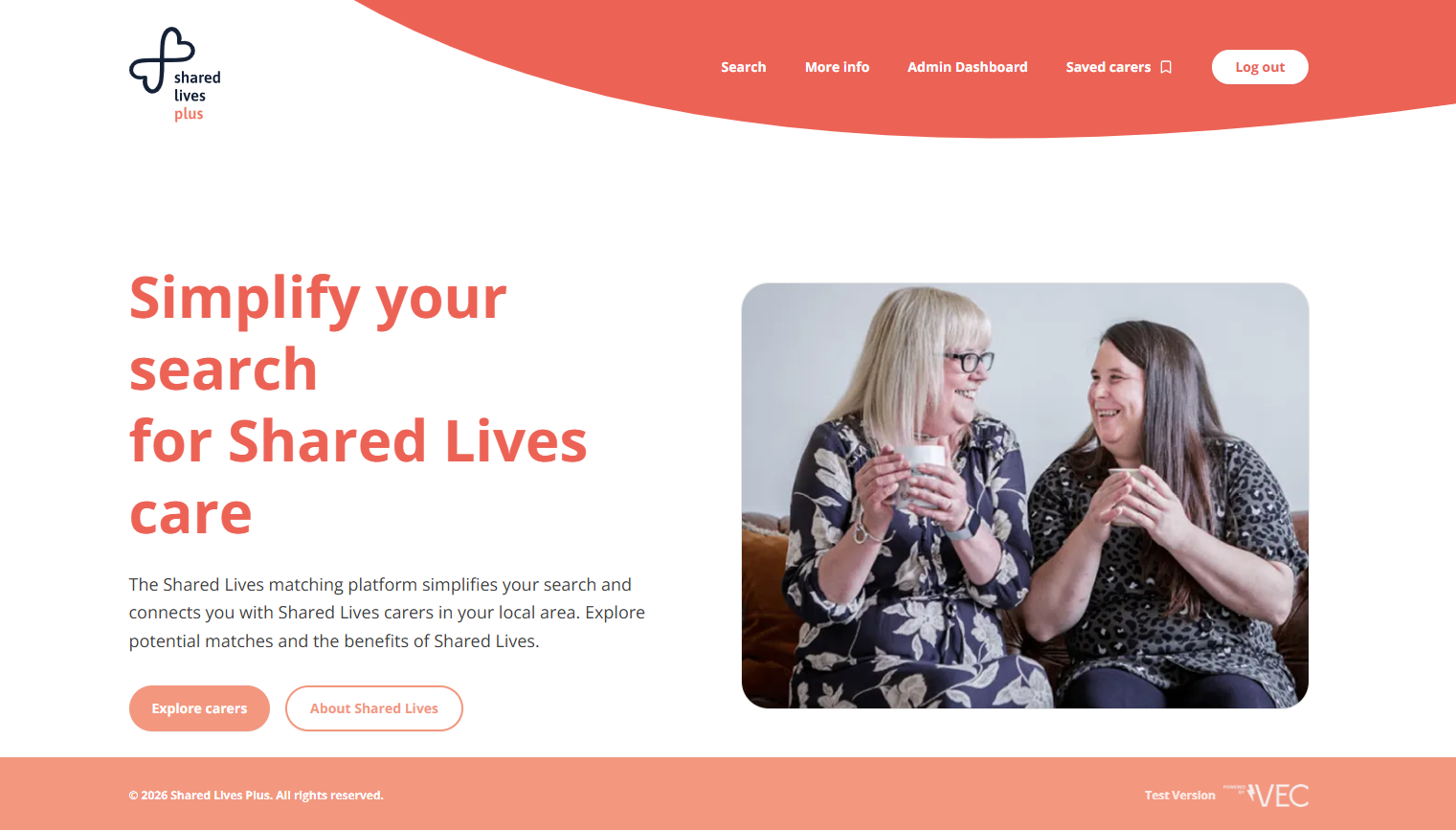
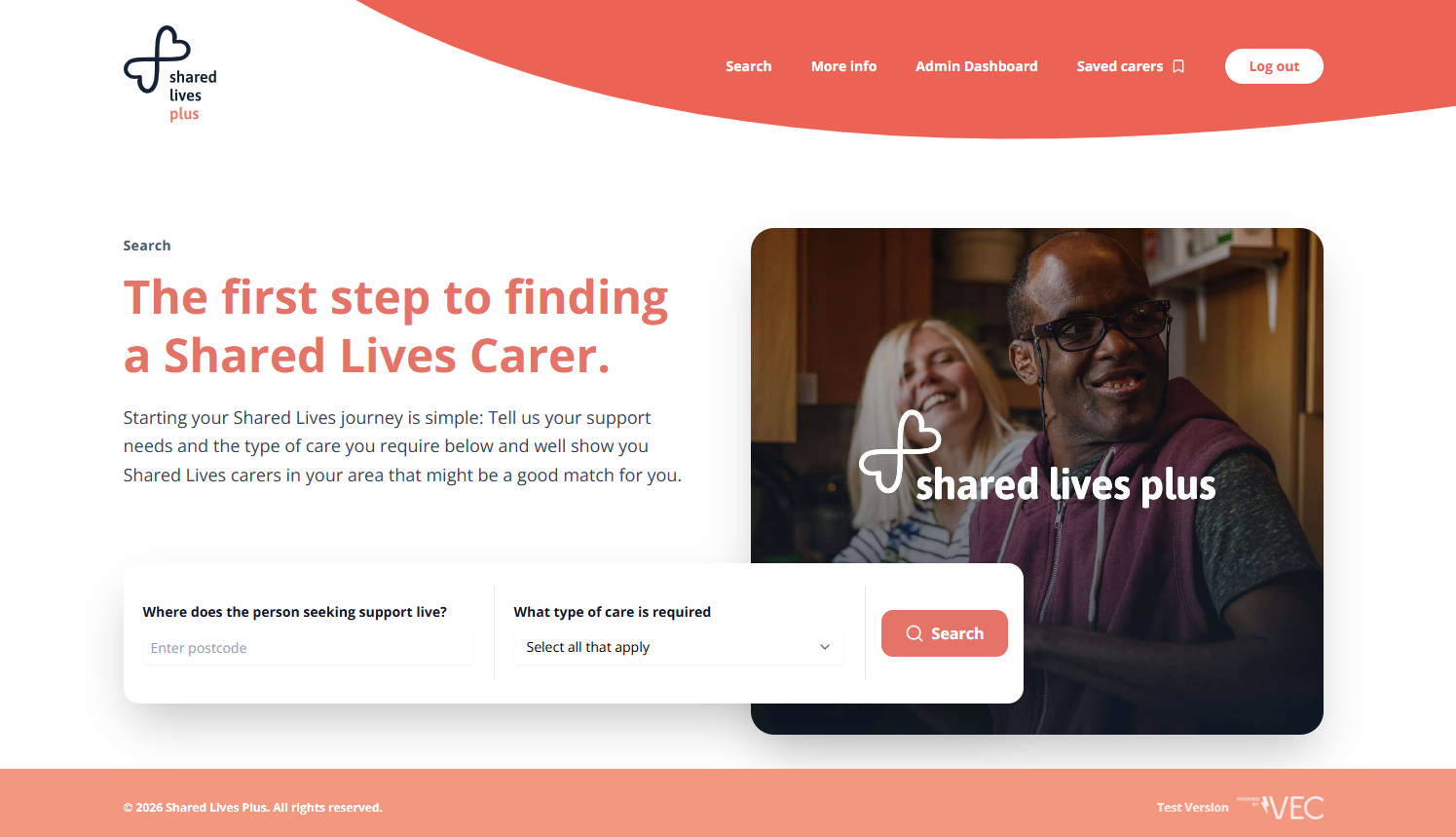
Rather than the University of Liverpool running testing as an external exercise, Shared Lives Plus decided to lead usability testing themselves. In this way, the product was tested in real operational contexts, with real users, while also building internal capability to continue improving it over time. The platform is now being piloted with a small number of schemes, including one operating in Wirral, using data from carers to understand how it performs and where it needs to evolve.
The result is a matching platform designed to support Shared Lives schemes and aims to:
Improve the visibility of available carers
Support better, more informed matching
Give people and families more choice and control
Create a more consistent approach across Schemes
One of the clearest lessons from this work is the value of starting with research. Early prototyping surfaced assumptions that could have been expensive to fix later. Designing within the context of the full service, rather than just the product, also increased the chances of the solution working in practice.
Just as importantly, building internal capability in design and testing has been as valuable as the product itself. Shared Lives Plus is now better equipped to shape and evaluate its own digital development moving forward.
Suzi Clark, Head of Strategic Advice and Development, at Shared Lives Plus, said:
“Our partnership with the testbed and VEC team in Liverpool provided pivotal design and technology expertise from the outset, supporting us to rapidly turn a well-researched idea and prototype, into a tangible tool to support the growth of the Shared Lives sector.
It upskilled our team to take forward the development and scaling of the platform to schemes across the Liverpool region and the rest of the UK, which we believe will lead to increased Shared Lives carer roles, and increased utilisation of Shared Lives on the whole, contributing towards a growing and sustainable Shared Lives sector”
The current platform is a starting point, not a finished product. The next phase will focus on learning from real-world testing, refining the product and exploring how it could scale across different Shared Lives Schemes to help grow the number of carers engaged in delivery of the service over time and relieve health and care systems under pressure across the country.
More broadly, the project shows that design-led digital innovation is possible in adult social care, even for organisations without in-house technical teams, when the right partnerships are in place.
If you are interested in exploring how the CHI-Zone could benefit your business, get in touch.