
Spotlight: Scenegraph Studios – advancing ethical AI avatars for mental health simulation training
Our Extended Reality (XR) for Community Healthcare Grants Programme is designed to help SMEs explore, develop and test XR technologies that are geared towards NHS adoption. We provide companies with targeted support, involving academic experts and technical specialists from the University’s Virtual Engineering Centre (VEC) as well as clinicians and patients from our NHS partners. Our aim is to improve outcomes for patients and professionals whilst supporting the growth of XR businesses working with the health sector in the UK.
One of the grant recipients, Birkenhead-based Scenegraph Studios, is developing Pxl-Persona, an AI-driven avatar platform designed to transform how healthcare professionals practise complex mental health conversations.
Healthcare professionals are often expected to recognise and respond to complex mental health needs after limited opportunities to practise safely. Traditional simulation methods such as actor-led roleplay are effective but costly, time-intensive and difficult to scale. Sessions depend on physical space, staff availability and fixed timetables, which means learners often spend more time observing than actively practising.
Scenegraph Studios’ approach replaces these constraints with immersive digital humans that behave in believable, context-aware ways. Learners can practise not just what to say, but how to say it - tone, pacing, follow-up questions, and emotional awareness. Over time, this builds transferable skills that carry into real-world interactions
Professor Dan Joyce, Director of Research and Innovation Mersey Care NHS Foundation Trust, our clinical partner of this work, said:
“Simulation training is effective but expensive in terms of time, space and staffing. Large groups often share limited time with actors, meaning much of the session is spent waiting rather than practising.
Scenegraph’s technology enables immersive, authentic simulation training without the need for physical spaces or synchronised schedules. Staff can train in their own time and repeat scenarios as often as needed. Unlike traditional sessions limited to a fixed slot, this allows for repeated practice, which is crucial for building confidence and competence.”
At the core of Pxl-Persona is the concept of Digital Twin personas. Rather than copying real individuals, the system models patterns of behaviour grounded in lived experience, culture and context. Each persona is built from layered components such as background, emotional tendencies, stressors and communication style, creating avatars that feel coherent and human rather than scripted.
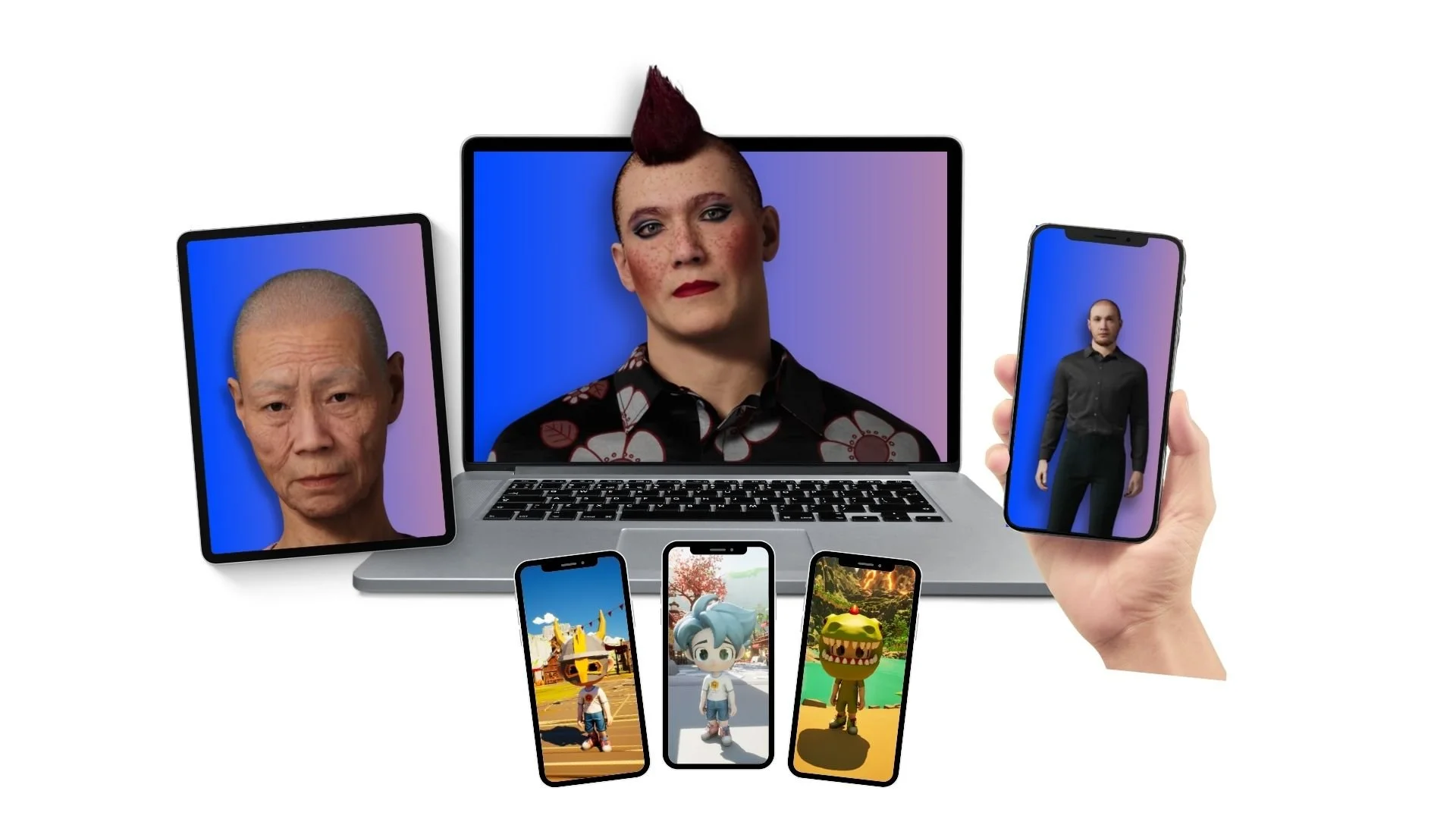
Within mental health training, this enables trainees to encounter realistic variation in how conditions may present depending on age, gender or life circumstances. Crucially, not everything an avatar says is treated as diagnostic truth. Learners are expected to ask follow-up questions and explore context, mirroring real clinical complexity rather than checklist-based assessment.
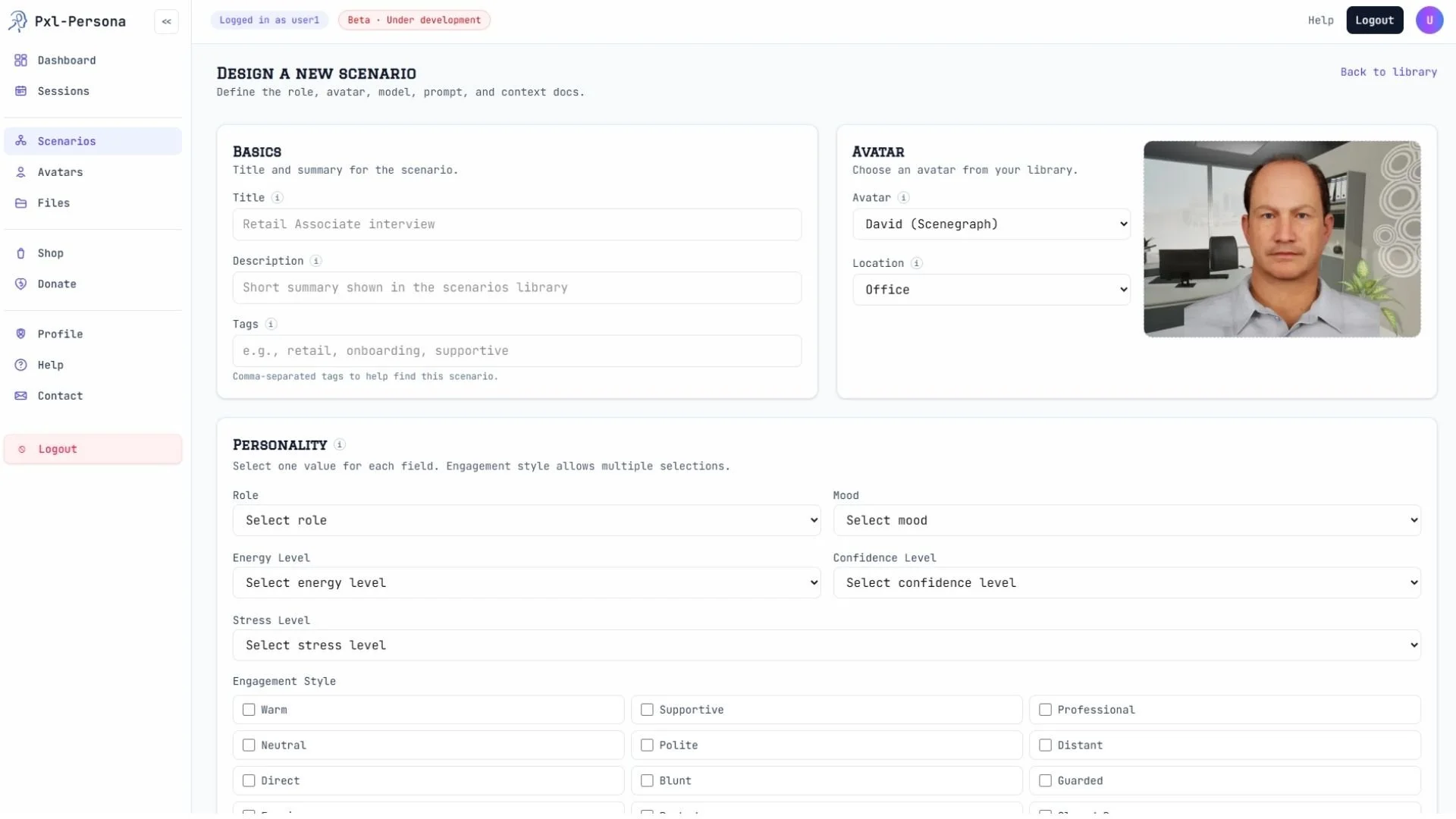
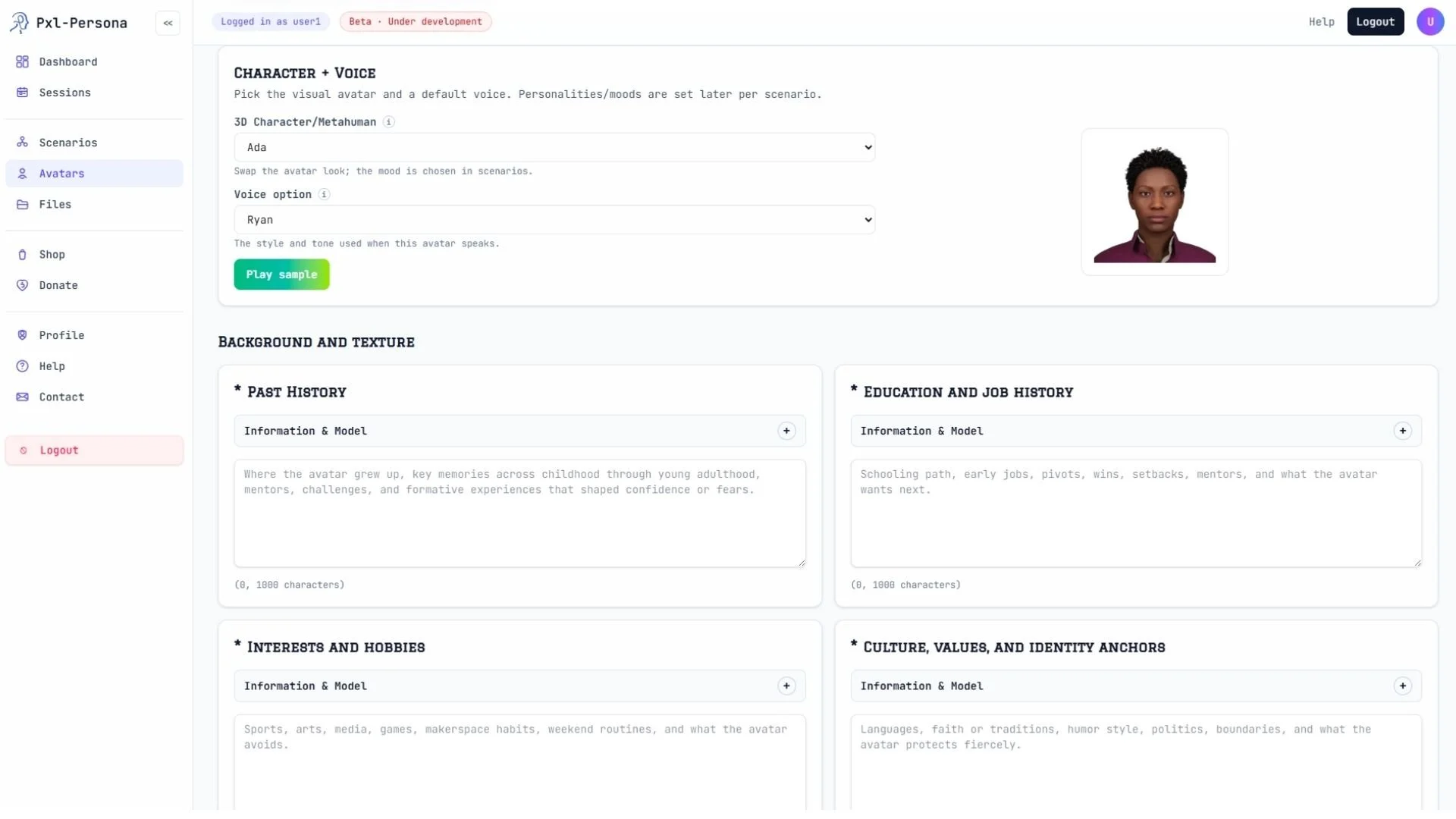
To support this, Scenegraph Studios is developing structured frameworks for both personas and scenarios. Trainers will be able to define factors such as cultural context, symptom intensity or scenario pressure through guided inputs rather than prompts or coding. This modular architecture keeps simulations consistent and clinically grounded while allowing controlled variation and scale.
David Tully from Scenegraph Studios said:
“Through the CHI-Zone programme, we are developing the next stage of our AI avatar research with academic and clinical support. The funding enables us to responsibly explore how AI avatars can represent lived experience, culture, and context, while establishing strong ethical and technical foundations. This work will support future developments, including culturally aware LLMs fine-tuned to create digital twins of people, places, and spaces, forming a scalable base for long-term research, products, and public benefit.”
The team’s approach prioritises consent-led, anonymised lived-experience input and avoids modelling specific individuals. Avatars are positioned as training tools rather than diagnostic systems, with defined behavioural boundaries and bias testing built in. The platform is designed for secure deployment environments aligned with NHS data expectations.
For Scenegraph Studios, our grants programme enables shaping the technology with the systems it aims to support rather than added afterwards. Co-design with clinicians and people with lived experience helps ensure relevance and real-world value beyond demonstration settings.
Long-term, the work goes beyond a single product. The aim is a repeatable, ethical framework for creating Digital Twin personas that can be adapted across healthcare, education and workforce training. By combining XR, AI, ethics and lived experience in a governed design system, Scenegraph Studios is contributing to scalable simulation that remains clinically valid and socially grounded.
Follow us on LinkedIn for the latest programme developments and find previous Spotlight posts here.